Our Father. Give us. Forgive us. Deliver us. That is the sound of the Christian community.

"Not forsaking the assembling of ourselves together... but exhorting one another." Hebrews 10:25
God Did Not Design Us to Walk Alone
There is something sacred that happens when God's people come together. It is more than a service, more than a sermon, more than music, and more than a familiar routine. The assembling of believers is one of God's chosen ways of keeping His people strong, encouraged, corrected, comforted, and spiritually alive.
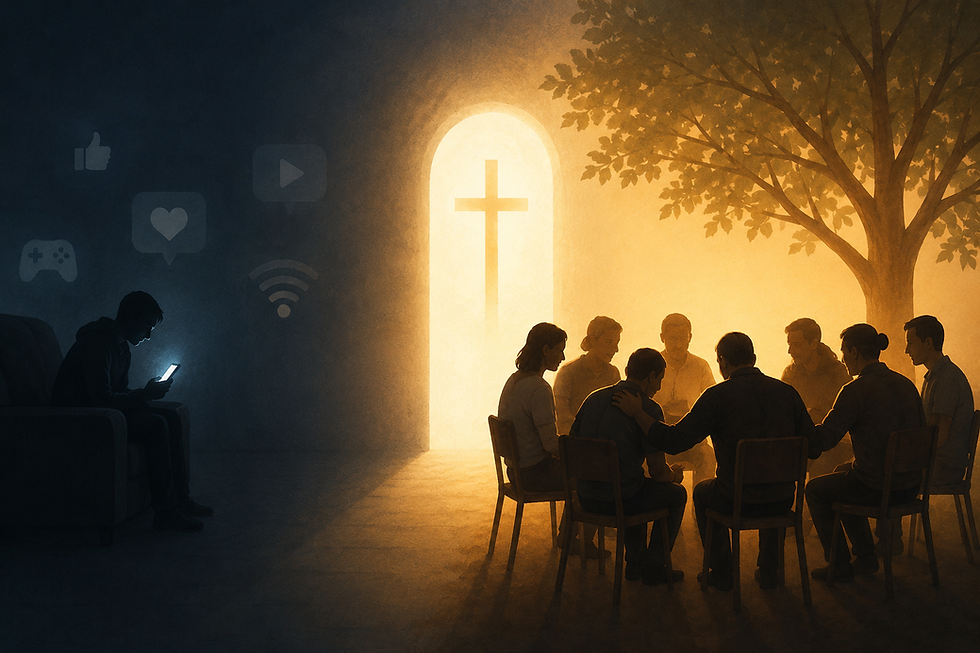
The Christian life was never designed to be lived in isolation. From the beginning, God said, "It is not good that the man should be alone" (Genesis 2:18). That statement reaches beyond marriage. It reveals something deeply woven into human nature: we were created for relationships. We need God, and under God, we need one another.
Modern research continues to confirm what Scripture has taught all along.
The U.S. Surgeon General's advisory on loneliness and isolation warns that a lack of social connection is associated with a higher risk of anxiety, depression, dementia, heart disease, stroke, and premature death. The CDC likewise lists depression, anxiety, suicidality, self-harm, dementia, and earlier death among the health risks connected with social isolation and loneliness.
In other words, isolation is not just an inconvenience. Prolonged isolation can become an unhealthy atmosphere for the mind and soul. A person can be surrounded by entertainment and still be lonely. A person can have hundreds of online contacts and still have no one who knows when they are drifting, grieving, tempted, discouraged, or in need of prayer.
The Lord's Prayer Is Plural on Purpose
One of the most beautiful proofs that Christianity is meant to be lived in community is found in the very prayer Jesus taught His disciples to pray. Jesus certainly valued private prayer. In the same chapter, He told His followers to enter the closet and pray to the Father in secret. But when He gave the model prayer, He did not teach us to speak as isolated individuals. He taught us to pray as a family.
Here is the full prayer from Matthew 6:9-13, King James Version:
After this manner, therefore, pray ye: Our Father which art in heaven, Hallowed be thy name.
Thy kingdom come, Thy will be done in earth, as it is in heaven.
Give us this day our daily bread.
And forgive us our debts, as we forgive our debtors.
And lead us not into temptation, but deliver us from evil: For thine is the kingdom, and the power, and the glory, for ever. Amen.
Notice the language: Our Father. Give us our bread. Forgive us our debts, as we forgive our debtors. Lead us. Deliver us. There is no "I," "me," "my," or "mine" in the prayer Jesus gave as the pattern for His disciples.
That does not mean a Christian should never say "I" or "me" when praying. The Psalms are full of personal cries to God. But it does mean that Jesus trains our hearts away from isolated spirituality. Even when we pray alone, He teaches us to remember the household of faith. We come to God as sons and daughters in a family, members of a body, sheep in a flock, and living stones in a spiritual house.
The singular words in the prayer, such as "thy" and "thine," are directed toward God: "thy name," "thy kingdom," "thy will," "thine is the kingdom." But when the prayer speaks from the human side, it is deeply communal. The worshiper does not stand before God as a detached individual saying, "My Father, give me my bread, forgive me my debts, deliver me from evil." Jesus places the language of the family on our lips.
A Closer Look at the Plural Language
The repeated plural language is not accidental. It teaches us how to think about prayer, provision, forgiveness, temptation, and spiritual safety.
Isolation Weakens; Godly Fellowship Strengthens
There are seasons when people are providentially hindered from gathering: sickness, caregiving, work demands, distance, persecution, disability, or other unavoidable burdens. God sees those situations with compassion. The church should see them with compassion, too, and should work to include and support those who cannot easily be present.
But there is a difference between being hindered and drifting away. There is a difference between solitude for prayer and isolation from the body. There is a difference between necessary rest and spiritual disconnection. Hebrews tells us not to forsake the assembling of ourselves together because God knows how easily distance becomes weakness.
A coal removed from the fire grows cold. A branch separated from the tree withers. A sheep separated from the flock becomes vulnerable. A believer cut off from fellowship becomes easier prey for fear, bitterness, temptation, false teaching, and despair.
But when the church gathers, the fire is stirred again. Someone walks in burdened and leaves encouraged. Someone walks in ashamed and hears about grace. Someone walks in confused and receives wisdom. Someone walks in lonely and remembers, "I have a family." Someone walks in weak and is strengthened by the faith of others.
Modern Media and the Illusion of Connection
One of the great dangers of modern life is that isolation has become convenient. We can be entertained without being known. We can be constantly stimulated without being strengthened. We can spend hours looking at faces on screens while avoiding the face-to-face relationships that require patience, humility, confession, kindness, and love.
Screens can pull each person in the room into a private world. Social media can give us the illusion of community while training us to perform, compare, react, and scroll. Video games can become endless digital kingdoms where we win battles while neglecting real relationships. Streaming services and online entertainment can keep us occupied for hours, not because we are rested, but because we are distracted.
Technology is not automatically evil. A phone can carry a prayer request. A message can encourage a discouraged saint. A livestream can bless the sick, the elderly, the homebound, or the traveler. But when digital connection replaces embodied fellowship, something precious is lost.
A text message cannot fully replace a hand on the shoulder. A livestream cannot fully replace worshiping in the room with the saints. A comment section cannot fully replace a church family that knows your name. A screen cannot fully replace being seen, heard, prayed for, corrected, embraced, and loved.
The Surgeon General's advisory even notes that heavy social media use can be associated with increased perceived social isolation. That should not surprise us. Digital tools can connect us when they serve love, but they can isolate us when they replace love.
The Church as God's Answer to Loneliness
The early church did not treat fellowship as an optional extra. Acts 2:42-47 describes believers continuing steadfastly in doctrine, fellowship, breaking of bread, and prayers. They worshiped together, ate together, shared together, and cared for one another. Their life together was a witness to the world.
That is still the ideal: a deep sense of family, community, and mutual support. The church should be a place where the older strengthen the younger, the younger honor the older, the strong help the weak, the hurting find comfort, the joyful share praise, and the weary are reminded to keep going.
The church is not a museum for flawless saints. It is a family for redeemed sinners. It is a hospital for the wounded. It is a training ground for disciples. It is a table where the hungry are fed. It is a household where the lonely are brought home.
Paul said, "Bear ye one another's burdens, and so fulfill the law of Christ" (Galatians 6:2). That cannot be obeyed from a distance of indifference. We must be near enough to know the burden, humble enough to share it, and faithful enough to keep walking together.
Do Not Forsake the Gathering
So do not forsake the gathering. Do not let entertainment slowly replace fellowship. Do not let convenience rob you of community. Do not let hurt convince you that isolation is safer than healing. Do not let the digital world train you to live detached from the people God has called you to love.
You need the church, and the church needs you. Someone needs your testimony. Someone needs your prayer. Someone needs your smile. Someone needs your encouragement. Someone needs to see you keep showing up. And you need theirs.
When Jesus taught us to pray, He gave us the language of family: Our Father. Give us. Forgive us. Deliver us. That is the sound of the Christian community.
We are not saved to stand alone. We are saved into a family. We are baptized into a body. We are called to walk together, worship together, suffer together, grow together, and one day rejoice together in the presence of our Lord.
So this week, gather with the people of God. Come with your burdens. Come with your praise. Come with your questions. Come with your weakness. Come ready to receive, and come ready to give.
Because in the Christian life, isolation weakens, but godly fellowship strengthens. And sometimes the very thing your soul needs most is found in the place Scripture told you not to forsake: the assembling of yourselves together.


Comments