So… Are You Tired of Your Domain Controller Yet?

There comes a point in every Horizon administrator’s life where they stare into the fluorescent glow of a Windows Domain Controller Server console at 2:13 AM and whisper:
“Why are you still here?”
Not to a user.Not to a manager.To a domain controller.
For years, virtual desktop infrastructure has carried around a strange emotional support animal known as “legacy Active Directory dependencies.” Entire architectures were lovingly assembled from LDAP binds, Kerberos tickets, Enrollment Servers, Certificate Authorities, trusts, sync connectors, and enough DNS conditional forwarders to summon an ancient spirit from the Windows 2003 era.
But today… something changed.
Omnissa quietly dropped a feature that made a lot of Horizon architects spit coffee onto their keyboards:

“Wait… Can Horizon authenticate users with Entra ID directly now and provide SSO functionality?”
Yes. Yes, it can.
The new feature is documented in:Add SSO Config for Entra ID SSO- https://docs.omnissa.com/bundle/GetStartedHorizonCloud/page/HorizonCloudTrueSSORequirementsforMicrosoftEnterpriseCertificateAuthorityandRequiredCertificateTemplates.html
…signals something much bigger than just “another authentication option.”
It signals the beginning of the:
“Maybe We Don’t Need All This AD Stuff”
The Ancient Ritual of Traditional Horizon Authentication
Historically, standing up Horizon with modern SSO often looked something like this:
Deploy Horizon
Deploy UAG
Deploy Workspace ONE Access
Deploy Enrollment Servers
Deploy Enterprise CA
Configure True SSO
Sacrifice three weekends to certificate templates
Explain to security why LDAP over SSL still somehow matters
Reboot a domain controller because “maybe replication is stuck.”
Pretend this is normal
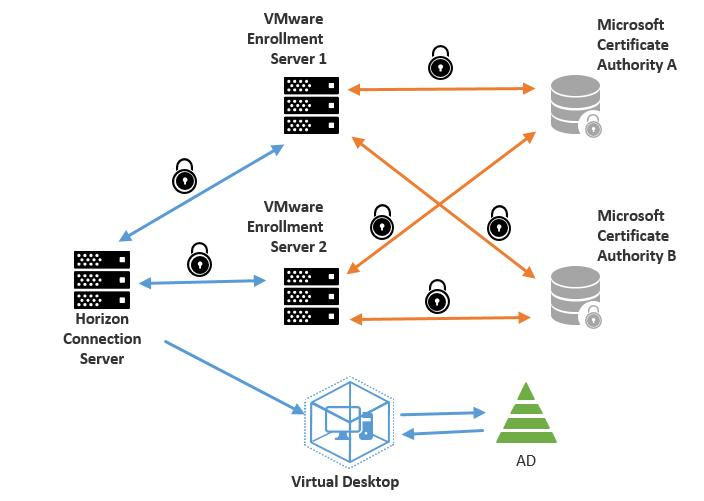
Traditional Horizon True SSO environments still rely heavily on Active Directory services, Enterprise Certificate Authorities, and Kerberos flows.
The architecture diagrams often looked less like “modern cloud identity” and more like:
“What if Microsoft Visio became emotionally unstable?”
Enter Entra ID SSO
Now Omnissa Horizon Cloud is moving toward something administrators have wanted for years:
Native cloud identity integration
Entra ID-based authentication
Reduced dependency on traditional domain-centric identity flows
Less infrastructure
Fewer Windows servers whose only job is “existing aggressively.”
And let’s be honest:
If your newest employee has never seen dsa.msc, that’s probably not a bad thing.
Omnissa has already been evolving Horizon Cloud and Omnissa Identity Services toward cloud-native identity patterns using Microsoft Entra ID and modern IdPs.
This newest SSO capability feels like another large step toward:
“Virtual Desktops and Apps with SSO without dragging a 20-year-old domain behind it.”
What This Means
Today
Before someone throws their domain controller into a wood chipper:
No — Active Directory is not completely dead in every Horizon deployment.
Let’s remain calm.
Today, there are still scenarios where:
AD is required
Kerberos still matters
Traditional True SSO flows are still used
Machine identity and certificate workflows still rely on the Microsoft PKI infrastructure
But the direction is becoming increasingly obvious.
The industry is shifting from:
“The domain is the center of identity.”
To:
“Identity is a cloud service.”
And Horizon is adapting accordingly.
The Real Story Here
This isn’t really about “removing domain controllers.”
It’s about removing dependency gravity.
For years, VDI projects have inherited:
legacy identity models
inherited trust relationships
old authentication assumptions
“We’ve always done it this way,” architecture
Now?Administrators can increasingly think in terms of:
conditional access
modern identity providers
cloud-native authentication
device posture
Zero Trust
federation-first access models
That is a massive architectural shift.
Somewhere… a Domain Controller Felt a Disturbance in the Force
Right now, somewhere in a datacenter:
A lonely domain controller is humming softly beside an aging file server.
It hears whispers.
“Entra ID…”
“Cloud-native…”
“Passwordless…”
It becomes afraid.
Its CPU spikes slightly.
An old Group Policy Object flutters in the wind.
The Bigger Picture for Horizon
What makes this especially interesting is that Omnissa is not simply “adding Entra ID.”
They’re steadily reshaping Horizon into something that looks increasingly platform-native for modern enterprise identity.
That means:
less friction for cloud-first organizations
simpler onboarding
Reduced infrastructure overhead
fewer supporting identity servers
more alignment with Zero Trust initiatives
cleaner authentication experiences
And perhaps most importantly:
Fewer meetings where someone says:
“Can we check if the LDAP bind account password has expired?”
Final Thoughts
No, domain controllers are not disappearing tomorrow.
But for the first time in a long time, Horizon admins can see a future where:
identity is cloud-native
authentication is modern
SSO is cleaner
and deploying six extra Windows servers isn’t considered “minimal architecture.”
Honestly?
That future sounds pretty good.
Even if the domain controller disagrees.
References
Omnissa Horizon Cloud Documentation – Add SSO Config for Entra ID SSO - https://docs.omnissa.com/bundle/GetStartedHorizonCloud/page/HorizonCloudTrueSSORequirementsforMicrosoftEnterpriseCertificateAuthorityandRequiredCertificateTemplates.html
Using Omnissa Identity Service with Horizon Cloud - https://docs.omnissa.com/bundle/IdentityServices/page/HorizonCloudServiceWithOIS.html?utm_source
Horizon Cloud Configuration – Tech Zone - https://techzone.omnissa.com/resource/horizon-cloud-configuration


Comments